
Announcing Patent Milestone: Revolutionizing Secure Data Interoperability for the AI Era
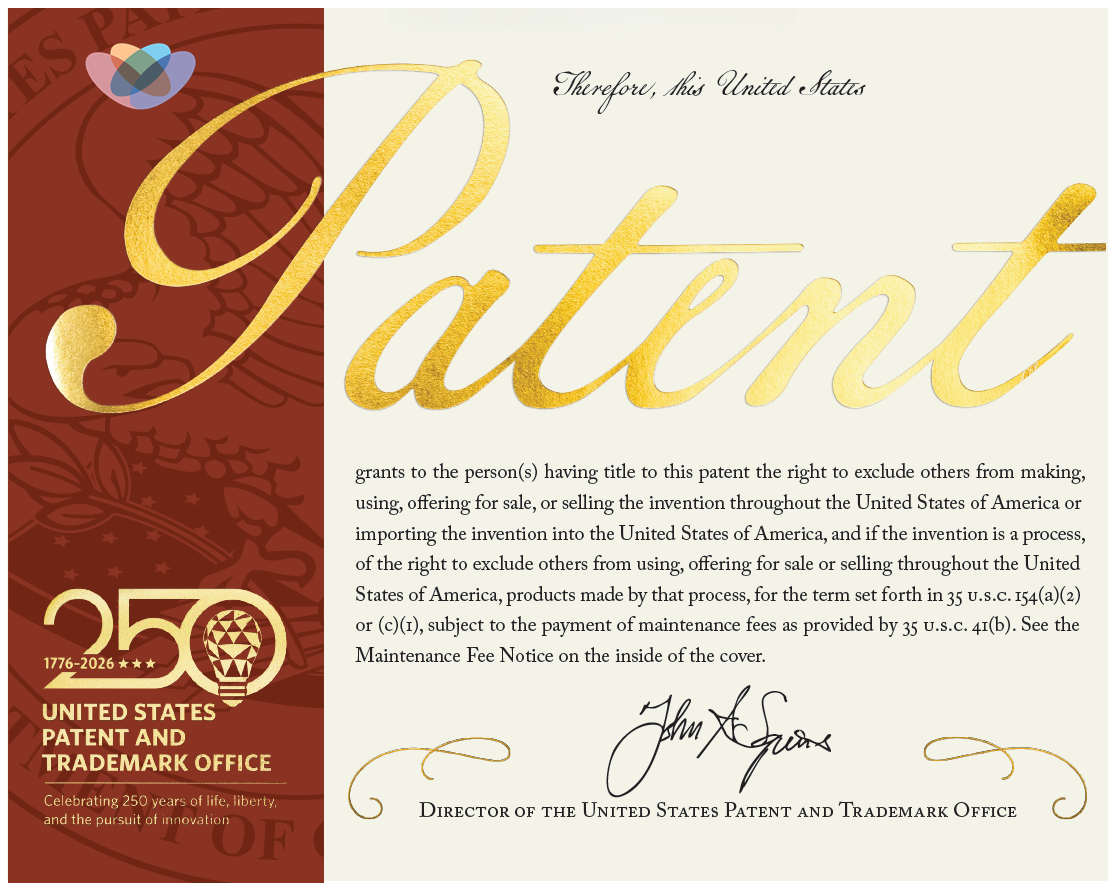
Lifetime Omics is pleased to share that the USPTO has granted us Patent #12625851, titled “System for Interconnecting Data Management for Scientific Research with a Registry for Publishing of Quality-Controlled Data.” This patent is the result of years of dedicated work between the co-founders and co-inventors, John Walker and Patricia Buendia.
The Strategic Value
In an era where data-driven insights and autonomous AI agents define market leadership, the primary obstacle for industries like healthcare, finance, and clinical research is restricted data access that fragments vital information across isolated silos. Our patented architecture solves this by replacing fragmented data uncertainty with a robust, domain-agnostic standard for in-place quality assessment and curation, transforming restricted, unusable silos into high-fidelity, AI-ready assets.
Key Technological Advantages
- Decentralized Registry Architecture: Our system enables centralized management of quality-controlled data, regardless of where it physically resides.
- Secure DNS Interoperability: Through a specialized DNS-based module, we provide a secure, standardized method for exposing curated datasets across diverse network environments, facilitating reliable data access for AI training and inference pipelines.
- Domain-Agnostic Curation: Originally developed for the complexities of research environments, this system provides a scalable pipeline for transforming raw, unstructured data into analysis-ready and model-ready data, a critical requirement for healthcare organizations scaling their AI capabilities.

The Path Ahead
With this patent secured, we are integrating our registry-based architecture into enterprise-level workflows. To accelerate this transition, Lifetime Omics is open-sourcing our core API Client Library. This provides developers with a standardized “bridge” to connect existing data pipelines directly to our registry. By sharing these tools, we will catalyze an ecosystem around our data curation standards with community contributions that enhance the platform’s capabilities. This open-source strategy is a deliberate move to accelerate AI adoption, foster open science, and drive long-term value for the wider data analytics industry.